With a vibrant economy and continental dimensions, Brazil has a domestic market that is often sufficient to build large startups. But for some businesses, national boundaries, however large, end up being narrow given the size of their ambitions. For these organizations, scaling isn't just about growing at home, but about finding new avenues of growth in other geographies.
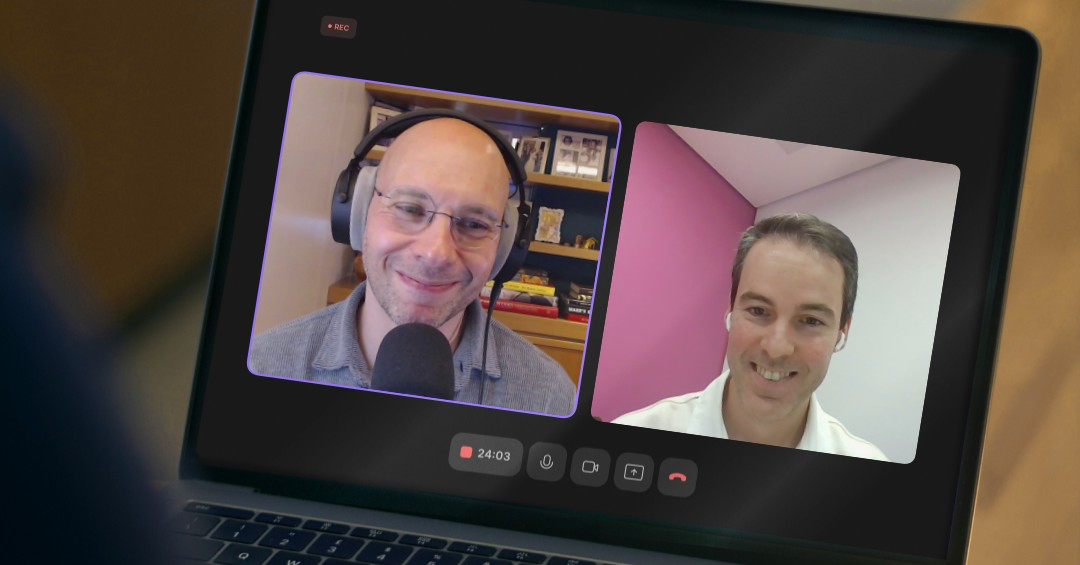
That mentality was evident in the last season of Astella Playbook, where our General Partner Daniel Chalfon spoke with three pioneers who dared to go beyond the national territory and look at international markets: Lorhan Caproni, founder of BotCity, Patrícia Osorio, co-founder of Birdie.ai, and Thiago Pessoa, Senior Vice President of Global Business Transformation at Wellhub, formerly Gympass.
Delving into these three episodes, we realized that, although the desire to achieve global success is the same, the paths taken to achieve it were different. Below, we break down the main lessons learned from these three cases of internationalization of startups, bringing their views on timing, leadership, culture, and sales.
Motivation: why cross the border?
The motivation to internationalize is rarely the same for everyone. For some, it's a matter of technical survival. For others, it's a strategic ambition. Understanding “why” is essential before defining “when”. However, every internationalization decision starts from the same principle: the understanding that a product solves a pain that is, in fact, universal. This is the only way a company is prepared to stop being local and become global.
Lorhan Caproni makes clear that, for Deep Tech startups, Brazil may have a maximum growth limit. BotCity needed a global scale because it competed with international players that had million-dollar budgets. According to him, “the size of the market in Brazil would not be enough for the size we want to reach with the company”.
Patrícia Osorio, from Birdie.ai, saw internationalization as a level change. The decision was conscious: “I don't want to play the Brazilian Championship but the World Cup,” she says. However, she provides an interesting counterpoint about the timing: even with the global ambition, Birdie used Brazil strategically as a testing environment to iterate the fastest and cheapest product before accelerating in the USA.
Finally, Thiago Pessoa refutes the idea that being born in Brazil is a disadvantage. On the contrary, he sees the Brazilian chaos as a true school. “There is a lot of flow in the Brazilian market. If you can navigate well there in Brazil, it's easy for you to navigate in other markets as well,” he says. For Wellhub, validating the model here created the “thick shell” needed for expansion.
The founder's dilemma: staying in the parent company or exploring the new?
Perhaps the point of greatest tension in the internationalization strategy is the choice of location and what should be the founders' focus in this process. And the trade-off is real: if the founder goes abroad, he signals commitment to the new market, but he risks leaving the main operation, which generally pays the bills, uncovered.
Regarding this point, Thiago Pessoa is the voice of caution. He argues that, in complex models, the founder must be the last to go. “It's very common to see founders being the first to fly and then leave the house unprotected.” For him, the ideal is to send trustworthy people to maintain the organization's DNA, but without sacrificing the management of the cash cow in Brazil.
On the other hand, Lorhan Caproni and Patrícia Osorio argue that the founder's presence is non-negotiable to unlock value in the beginning. Lorhan realized that, to raise capital with American funds, for example, location was a trust barrier. He noted that the investors' doubts were not about their nationality, but about the focus: “It wasn't the fact that I was Brazilian, but the fact that I was in Brazil.” Moving to San Francisco was essential for him closing his Series A round.
Patrícia reinforces this vision from a sales perspective. To close the first contracts with corporations, the owner's badge weighs. “The founder makes more difference in these first large contracts than a person from the United States,” she says.
Language as an operating system
Internationalizing is not just translating the site, but rewriting the company's cultural code. When distributed teams start operating in different time zones, asynchronous communication and clarity become vital. The challenge is no longer just geographical and is about belonging and alignment.
Wellhub, for example, adopted a practice to avoid creating national silos. Thiago says that they implemented the”English First“ approach: meetings and documents are in English, even if there are only Brazilians in the room. He warns that the original culture never survives intact: “The most classic mistake that exists is to believe that you can keep the same DNA, but [with internationalization] the culture will change”.
Lorhan complements that vision with the reality of modern remote work. For BotCity, hiring global talent required a change in mentality where the focus is on “less geography and more timezone”. The English language has become the standard tool for uniting developers from India, Europe, and America.
Patrícia, on the other hand, brings the human nuance to this process. She recalls that, even with English as the official language, cultural differences remain between the lines, as in the case of performance feedback. Brazilians tend to be more empathetic, while other cultures are direct. Without care, communication breaks down. “I spoke in a very objective way, people said that I was being very cold” she recalls about the challenges of cultural adaptation.
Go-to-market: from warm intros to PLG
How to sell in a market where no one knows your brand? A common answer is to “spend money on marketing.” Our guests, however, prove that efficiency comes from the network and product strategy, not just the media budget.
Patrícia Osorio is emphatic: “What I don't believe makes a difference is throwing money [to accelerate the go-to-market]”. Instead, she “hacked” the system using the Brazilian diaspora. Birdie.ai accessed Brazilian executives in large global corporations to open doors, using the common identity to obtain the warm intro that a Cold Mail could never do it.
Lorhan Caproni, operating in the technical world, bet on Product-Led Growth (PLG). The strategy was to get the product into the hands of the developers before trying to sell to the CIO. He has valuable advice for those who navigate technology waves (such as AI): “When the hype is at its peak, the answer lies with the customers.” Focusing on real user pain, and not on market noise, was what guaranteed BotCity's traction globally.
Finally, Thiago Pessoa brings simplicity as a weapon. He criticizes the tendency of founders to want to “play War”, designing complex strategies for global domination ahead of time. His recommendation is tactical and direct: “Pick up the phone and start scheduling a meeting.” Validating the problem with real conversations is cheaper and more effective than opening CNPJs in five countries simultaneously.
What is the size of the prize?
Crossing the stories of Birdie.ai, BotCity, and Wellhub, it is clear that there is no single Playbook to internationalize a startup. The founder may be the first to go to the new location or stay in Brazil, the global growth strategy may be PLG or relational sales, and Brazil may serve as a springboard or laboratory.
At the end of the day, what unites these three founders is execution discipline and clarity about the ultimate goal. Thiago Pessoa closed our season at Astella Playbook with a provocation suitable for any founder with a desire to conquer the world: “What is the size of the prize?”.
When internationalizing, it's easy to get lost in operational complexity. The key question is: is the effort you're making now to earn pennies or to unlock millions?
Brazil is a hotbed of talent and global businesses. The world is big, but it's accessible to those who, like Thiago, Patrícia and Lorhan, have the courage to not only dream, but to execute across borders.
If you want to delve deeper into these cases, I recommend listening to the full episodes on Astella Playbook. Listen now by clicking on the links below:
- Lorhan Caproni from BotCity: how to internationalize a deep tech startup
- From Brazil to the world: Pat Osorio, co-founder of Birdie.ai, and what nobody tells you about scaling a global startup
- Unraveling internationalization: Thiago Pessoa, from Wellhub, tells the secrets of building a global business


Next Episode
Próximo Episódio