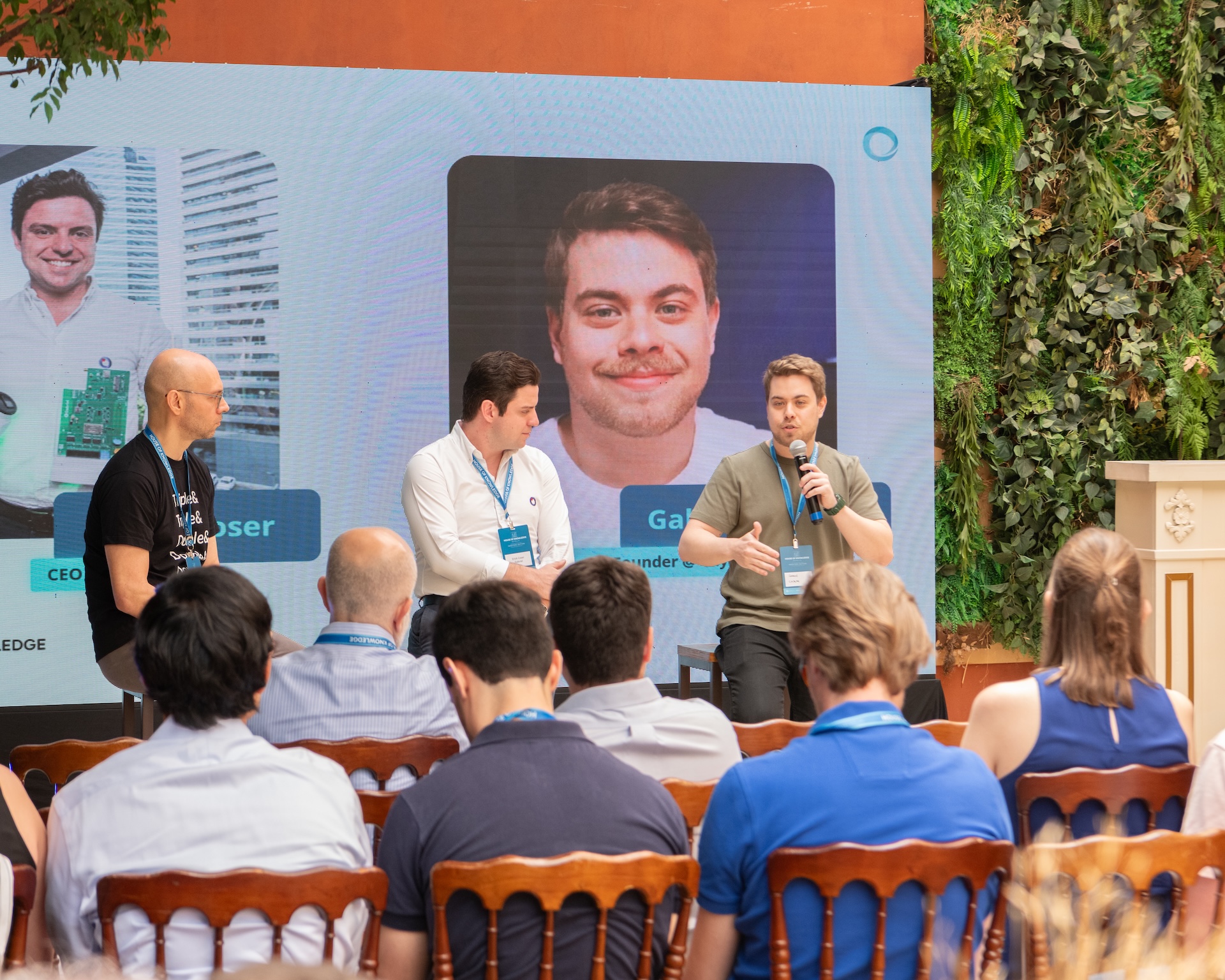


On stage at the House of Knowledge: Investors Edition — an event held exclusively for our investors — the founders Gabriel Sendacz (Cayena) and Erick Coser (Gabriel) spoke live with our General Partner Daniel Chalfon about their entrepreneurial journeys, the structural challenges they are facing and the new funding scenario with global investors.
What does a startup that installs surveillance cameras on dark streets and a marketplace that digitizes the purchase of supplies for restaurants have in common? Despite different business models and industries, both are trying to solve major structural problems in Brazil, or as we like to say, they are “doing the hard thing”.
Gabriel and Cayena are startups invested by Astella who chose not to ignore Brazil's complexity. On the contrary: its founders built businesses that face the country's structural problems head-on. Gabriel decided to attack public safety challenges, while Cayena decided to untie the knots of logistical inefficiency in food retail. Both decided to do this through technology, creating barriers to entry that few are able to cross.
During our event House of Knowledge: Investors Edition, our GP Daniel Chalfon conducted an honest conversation with the two entrepreneurs. They unveiled the backtstage of their operations, discussed the setbacks and victories of their journeys, and shared their views on the current catchment scenario in the Brazilian ecosystem.
Below, we summarized the best moments from that conversation for you:
Daniel Chalfon: Astella likes to invest in solving major Brazilian problems. Technology is often the only way to address these issues at scale. You work in two of the most complex sectors in the country: food and security. What are you doing differently that traditional mechanisms have failed to do?
Erick Coser (Gabriel): I think a lot about one statistic: the number of cameras per thousand inhabitants. London, the cradle of liberalism, has 60 cameras per thousand inhabitants. Beijing has 370. São Paulo, before initiatives such as Smart Sampa and Gabriel, had about four.
No society on the planet has the money to put a police vehicle around every corner. The camera is a proxy of investment in technology to generate intelligence. The problem is that, unfortunately, many resources are allocated statically, at geographically fixed points, and not where the criminal stain is taking place.
Gabriel didn't invent the wheel. What we did was create a model where the private sector finances this security. We “atomize” the product. By combining several cameras, we were able to deliver an intelligence network at a radically lower cost.
Today, our network processes 80 million license plate readings per month and generates an alert for vehicles involved in crime every minute, integrated with the police. We don't want to live in a country where security is privatized, but if the private sector is willing to collaborate with the State, we align the incentives to combat impunity.
Gabriel Sendacz (Cayena): In our case, the problem is logistical and purchasing inefficiency. The restaurant owner spends a significant part of the day quoting prices on WhatsApp with multiple suppliers or visiting wholesalers physically. It's an insane routine.
Cayena's value proposition is to bring the quotation of more than 150 distributors in the palm of your hand, in real time. Then the market's inefficiency comes in: the price variation of the same item, such as a piece of sirloin or mozzarella, is up to 35% between suppliers on the same day. As we do arbitration, the customer saves between 15% and 20% on the CMV (Cost of Merchandise Sold) just by buying better.
To make this work, we had to build an API infrastructure from scratch to connect distributors that use archaic ERPs, made in Cobol 20 years ago, and who had never heard of the cloud. We are the only player that can bring these quotes in real time because we did the hard work of connecting this fragmented end.
Daniel Chalfon: Both companies have international investors in Cap table and raised relevant rounds recently. What is the investor's current perception of Growth a foreigner in relation to Brazil?
Gabriel Sendacz: Being very transparent: the bar went up. On a recent trip to New York and San Francisco, we spoke with about 40 funds. The feeling is that there is a low appetite distinction for investing specifically in Brazil; they put us in a big bucket called “Rest of the World”.
The investor is more mature. If you are a solid company, with fundamentals, there will always be capital. But that easy money from 2021, based solely on a good idea or surfing a trend, is over. Today, it's hard to bring in outside capital if you don't prove that you're a company with long-term growth capacity and a clear path to liquidity.
Erick Coser: I completely agree. I heard from a fund investor High Profile the following sentence: “I understand that you can be a billion-dollar company. But that doesn't move the needle from our $4 billion fund. To invest in Brazil, with exchange and exit risks, I need to be clear that it could be a return of 5 billion dollars”.
Another point is that if you are not at the top — in Top Quartile or the top 10% — you don't even sit at the table. And if you don't have a clear Artificial Intelligence narrative, it gets even more difficult. It has to be an investment No-Brainer: “I put in 1 dollar and 3 come out on the other side”. As Jason Lemkin [from SaaStR] says, it's not that it's been difficult now; it's just returned to historic normal. 2021 was the exception that didn't exist.
Daniel Chalfon: Speaking of AI, you can't ignore the topic. You were born before the ChatGPT “boom”, but technology directly affects your business. How is AI changing the Cayena and Gabriel operation in practice?
Gabriel Sendacz: We had a fear: “Do we need to be a company? AI Native to capture?”. But we've heard a lot of skepticism from investors out there about companies that are just AI “wrappers”. They value those who have the fundamentals to use AI within the business and, especially, those who have Moats (entry barriers) so as not to be disrupted by it.
At Cayena, we use AI for efficiency. We received unstructured data from suppliers, such as “Contra filé C Friboi”. What is “C”? Is it with bone? Is it a box or a unit? Before, we struggled to classify this. Today, AI gets 95% of those ratings right based on supplier history.
We're also using it for sales productivity. AI has already warned our representatives: “Customer X always buys pepperoni on Tuesday and didn't buy it today; offer it”. The next step is a sales co-pilot and, in the future, the replacement of conversational selling on WhatsApp with an AI that simulates the representative, available 24/7.
Erick Coser: I was always paranoid that my biggest competitor was the company that had not yet been born. And with AI, that technological barrier has been lowered. But our biggest competitive advantage is having done the “hard thing”: installing physical hardware, 3-meter-high poles, and computers on the edge.
Today, we are vertically integrated. We install, maintain, and process video on local equipment. That gives us a gross margin of 65%, which is rare. Our cloud cost remained stable even though the number of customers grew 40 times, because we processed at the edge.
In the new model that we are going to launch, the “Chameleon 3", the processing capacity will be absurd. We will be able to capture structured metadata from the street: color of the car, color of the pedestrian's clothing. At the limit, a police officer can send an audio on WhatsApp: “I want to see all the red motorcycles that passed through my region in the last two hours”. And the system returns in seconds. That's computational power applied to the real world.





.avif)


